
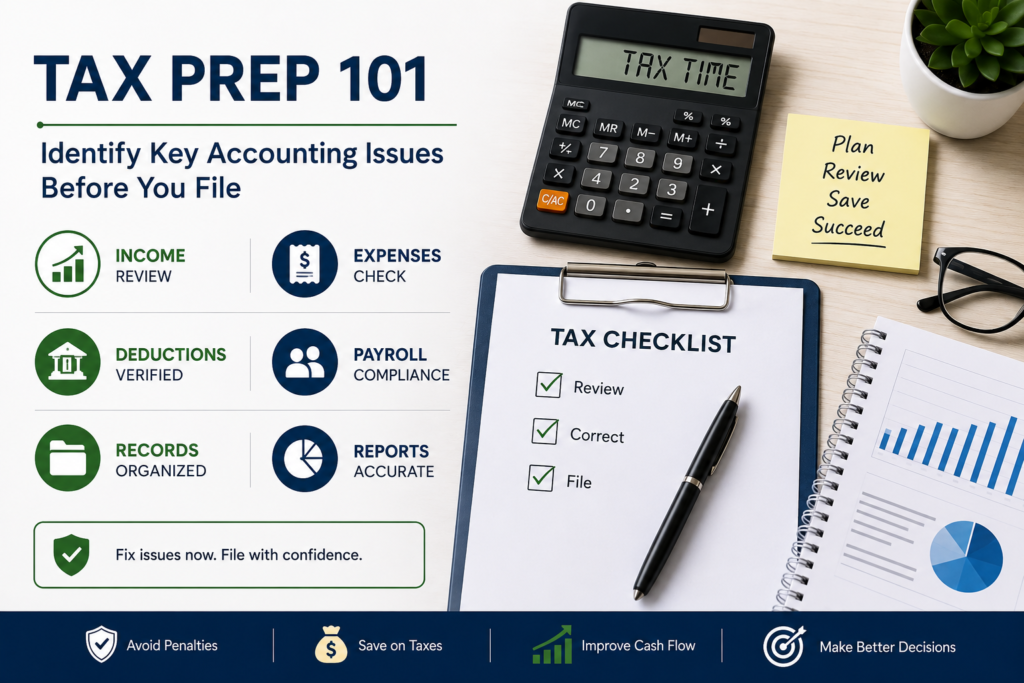
Tax Prep 101: Identifying Critical Accounting Issues Before Tax Filing
Preparing for tax filing is a crucial process for businesses and individuals, and addressing certain accounting issues beforehand can prevent errors, penalties, and missed opportunities for tax savings. As an experienced CPA, I would identify three critical accounting issues to address before preparing and filing taxes:
Ensuring Accurate Record-Keeping and Financial Reconciliations
Proper and accurate record-keeping is the foundation of tax compliance. Before filing taxes, it’s essential to ensure that all financial data is complete, accurate, and reconciled.Key Actions to Take:
- Reconcile Bank Accounts and Financial Statements:
- Compare your general ledger to bank statements, credit card statements, and any loan accounts to ensure all transactions are accounted for.
- Resolve discrepancies, such as missing or duplicate entries, to prevent over- or underreporting income or expenses.
- Review Expense Categorization:
- Check that all expenses are properly categorized as deductible business expenses, personal expenses, or non-deductible items. Misclassification can lead to errors in tax calculations or audits.
- Audit Trail for Transactions:
- Ensure there’s a clear audit trail, including receipts, invoices, and supporting documentation, for every reported income and deductible expense.
- Inventory Valuation:
- If your business deals with inventory, confirm that inventory valuation methods (e.g., FIFO, LIFO, weighted average) are consistently applied and align with tax regulations.
Why This Matters: Accurate records are critical for preparing a reliable tax return. Errors or omissions in financial records can result in penalties, interest, or even audits.

Identifying and Leveraging Tax Deductions, Credits, and Adjustments
A proactive review of available tax deductions, credits, and adjustments can significantly reduce the tax liability. CPAs should help taxpayers or businesses identify opportunities for tax savings.Key Actions to Take:
- Maximize Deductions:
- Review deductible expenses such as:
- Business expenses (e.g., office supplies, travel, meals).
- Depreciation and amortization on business assets.
- Home office expenses (if applicable).
- For individuals, consider deductions for student loan interest, medical expenses, or charitable contributions.
- Review deductible expenses such as:
- Capture Tax Credits:
- Tax credits offer dollar-for-dollar reductions in tax liability. Common examples include:
- Research & Development Tax Credit for businesses.
- Child Tax Credit or Earned Income Tax Credit for individuals.
- Energy-efficient property credits (e.g., solar panel installation, electric cars and energy efficient appliances).
- Tax credits offer dollar-for-dollar reductions in tax liability. Common examples include:
- Adjustments to Income:
- Consider adjustments like contributions to retirement accounts (e.g., IRAs) or Health Savings Accounts (HSAs), which reduce taxable income.
- Carryforwards and Carrybacks:
- Review net operating losses (NOL), capital loss carryforwards, or unused tax credits from previous years that can offset current-year taxes.
Why This Matters: Failing to claim eligible deductions or credits means overpaying taxes, while improperly claiming them can trigger penalties or audits.
Learn About — Importance of Financial Statements
Compliance with Tax Regulations and Deadlines
Tax laws and regulations change frequently, and staying compliant is essential to avoid penalties or legal issues. Understanding deadlines and specific tax obligations ensures a smooth filing process.Key Actions to Take:
- Understand Entity-Specific Requirements:
- Businesses must adhere to tax rules based on their structure (e.g., sole proprietorships, S-corporations, partnerships, or C-corporations). For example:
- S-corporations must ensure proper reporting of shareholder distributions.
- Partnerships need to prepare Schedule K-1s for partners.
- Businesses must adhere to tax rules based on their structure (e.g., sole proprietorships, S-corporations, partnerships, or C-corporations). For example:
- Estimate and Pay Quarterly Taxes:
- If applicable, confirm that estimated quarterly tax payments were made throughout the year. Underpayment of estimated taxes may result in penalties.
- Track New Tax Law Changes:
- Review recent updates to tax laws (e.g., changes in standard deduction amounts, corporate tax rates, or qualified business income deductions). Tax law changes can impact the filing process and tax liability.
- Compliance with Reporting Requirements:
- Verify that all necessary forms are completed:
- W-2s and 1099s for employees and contractors.
- Forms for foreign income or assets (e.g., FBAR, FATCA compliance).
- Proper tax treatment of cryptocurrency transactions, if applicable.
- Verify that all necessary forms are completed:
Why This Matters:
Failure to comply with tax regulations, deadlines, or reporting requirements can lead to penalties, interest, and potential legal issues.
Conclusion
By addressing these three critical accounting issues—accurate record-keeping, leveraging deductions/credits, and compliance with tax rules—taxpayers and businesses can minimize errors, reduce tax liability, and stay compliant with tax laws. A CPA’s attention to detail and proactive planning ensures a smooth tax filing process and protects against unnecessary financial or legal risks.